
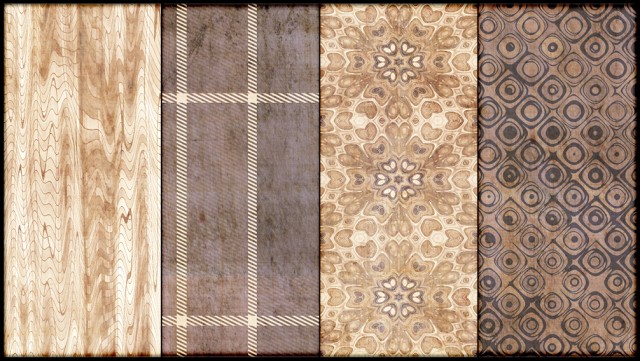
A client sends a deck with a pattern swatch pasted into the corner of slide four. No .pat file, no name, no source. Twenty minutes before the call, and that repeat has to be rebuilt by hand.
Twenty-five free sets that still earn a place. Most download, a few lost their pages and we say which, and each gets a note on how it tiles. That part separates a texture from a default.
What a pattern tile actually needs
Two things decide whether a pattern is usable: tile size, and what happens at the edge. A motif crossing the boundary has to appear again opposite at the same offset, and Photoshop will not fix that for you. It repeats the mistake, cleanly, forever.
The check takes ten seconds. Filter > Other > Offset at half width and height with Wrap Around on, then look at the centre. A seam there appears on every tile in the document. Soft textures forgive one. Hard geometric edges never do.
Geometric sets that survive scaling
Hard edges, maths-driven repeats, no tolerance for error. These four get opened for packaging and editorial grids.
12 Optical Coloured Squares Patterns

Op-art squares with a hard edge on every side. Misregistration shows as a diagonal jump, not a smear. Keep the fill at 200px or larger.
Chevron Patterns

A true zigzag only holds if the point lands on the tile edge. Drag the fill handle and the stripes shear instead of widening. That is sizing, not a broken file.
14 Plaid Checkered Patterns

Plaid lives or dies on line weight. Under 150px the weave collapses into grey. This wants 400px and a mockup, not a web header.
Minimal 8

Black micro-geometrics: diamond lattice, zigzag, fine dot grid. Tile at 40 to 60px. At 30% zoom they go moiré, and no setting fixes that.
Painted and floral, for print work
Loose brushwork and botanical repeats, the oldest use for a pattern: paper goods, packaging, anything heading for a press. All want 300dpi and no scaling.
16 Mottled Painted Floral Patterns

Sixteen variants, and the mottling is the point: densities differ enough to pick a sparse tile that sits behind a headline. Judge it at final size.
Floral Photoshop Patterns

Four tinted grounds, flat leaves, daisies, .PAT plus JPEG swatches. Personal use with credit required, so it is a moodboard texture, not a deliverable.
Anigraphuse Persian Patterns Slimi

Fine line ornament at small scale. Anything this intricate sits at 1:1 or larger; scale it down and the detail fills in with grey.
Painted Patterns

Eight 600×600 crosshatch scribbles, one colour per tile. The diagonal strokes give it a direction, so you cannot rotate it and call the texture neutral.
Pink Photoshop Patterns

The Apricum blog went dark years ago, so this preview is the record rather than the door. Small motifs on light grounds; rebuilding it takes ten minutes.
Ornament and period pieces
Victorian – PS Patterns

Scanned 19th-century ornament, black on white, from a 2008 stock post. Needs a pattern overlay plus colour overlay; flat, it reads as a photocopy.
Vintage Retro Grunge Wallpaper Patterns, parts 6 and 7


Scalloped art-deco fans, eight colourways per part, with part 7 at heavier distress. The source site is offline, so the previews are what survives.
Surfaces: cork, mesh, paper, fabric
Texture sets behave differently, because noise hides seams. Half forgive a bad join. Half punish it.
8 Cork Noticeboard Patterns

Noise-heavy and low contrast, which is exactly why it tiles invisibly. In a mockup at 300px, nobody finds the repeat without a ruler.
Leopard Pattern

Animal print is entirely scale-dependent: at 150px it reads as a spot, at 40px as grey noise. There is no middle setting that looks deliberate.
Metal Mesh Patterns

A grid rather than a scan, so it stays clean at small sizes. Multiply over a photo for grilles and windows; it survives a 50% reduction.
Paper Patterns

Scanned paper with fibre and tone shifts, subtle enough for body copy. The texture is the seam, so it forgives. Multiply, under 30%.
8 Tileable Fabric Texture Patterns

Woven threads in two directions, the classic failure case: a weave crosses itself at every repeat. One tile on one panel beats a 3×3 grid. No download.
Grungy Natural Beige Photoshop Patterns

Soft grunge in warm neutral, built for multiply layers over photos. Worse in print, since the grain is baked at screen size. Page gone.
Dark, loud, and space
12 Psychedelic Circles Patterns

Lava-lamp blobs in twelve colourways. Useless at full strength; at 15 to 25% opacity over a dark section it becomes a background, not a joke.
Tileable Classic Nebula Space Patterns

Worst candidate for tiling: the same bright stars in every repeat, and once a viewer spots it, the illusion dies. Source gone.
Midnight Blue Patterns

Dark, low-contrast, forgiving. White text sits on it without a scrim, and at 200px the repeat is invisible.
Loose ends worth a download
Abstract Seamless Pattern Set (Abstract) 1 by Anigraphuse

Large organic shapes with clean vector edges. Tiles well at 500px and above; below that the shapes crowd and negative space closes.
Retro Patterns

A 2010 set of flat shapes and halftone repeats. Recolouring is trivial, which is the real reason to keep a retro pack, not nostalgia.
Spiderman Pattern, a cool mesh pattern

Ignore the name. It is a webbing grid, the closest thing here to a technical mesh overlay, and it earns its place on app screens.
Free Photoshop Patterns

Eight pale blue microprints: tiny motifs on light grounds, invisible seams. Text stays readable on top, which is why it gets used when a brief asks for texture but nothing loud. Site offline.
Loading .pat files without breaking anything
Drop the file on the canvas and it lands in the Patterns panel. Make a Pattern Fill layer, not Edit > Fill; the layer keeps a live scale and angle.
One number to keep in mind: a 64px tile shown on a 2x screen is 128 device pixels, which is why micro-geometrics that look calm in the panel come out as coarse noise in a retina export, and as a visible grid on a projector at the back of a room.
Two failures worth knowing. A .pat built in CMYK will not import, since the format stores RGB only. And a 100px tile bands across an A2 at 300dpi. That is the resample, not the artwork.
Questions about Photoshop patterns
Why is there a visible line between tiles?
A motif crosses the tile edge and does not continue opposite. Run Filter > Other > Offset with Wrap Around at half width and height, then nudge until the join closes in the middle.
Do .pat files still work in current Photoshop builds?
Yes, and the import path has barely changed in a decade. Affinity Photo and Photopea open most .pat files, Illustrator will not. Keep the tile as a PNG and you are covered.
Can these patterns go into paid client work?
Depends on the page, and they are inconsistent. Brusheezy sets are usually free for commercial use with terms per upload, Grandma’s Flowers is personal use with credit, DeviantArt stock follows each artist. Where a page is gone, do not assume public domain.
Keep going
If you want the rest of our working files, the 40 PSD logo mockups put these textures to work, and the gradient generator covers the cases where a pattern is wrong. The rest sits in Freebies; the shelf is at Design Tools.
Leave a Reply